

Trump's Economic Policies Show Mixed Impact: Macro Gains Amid Middle-Class Pressures With Some Retirement Savings Boosts
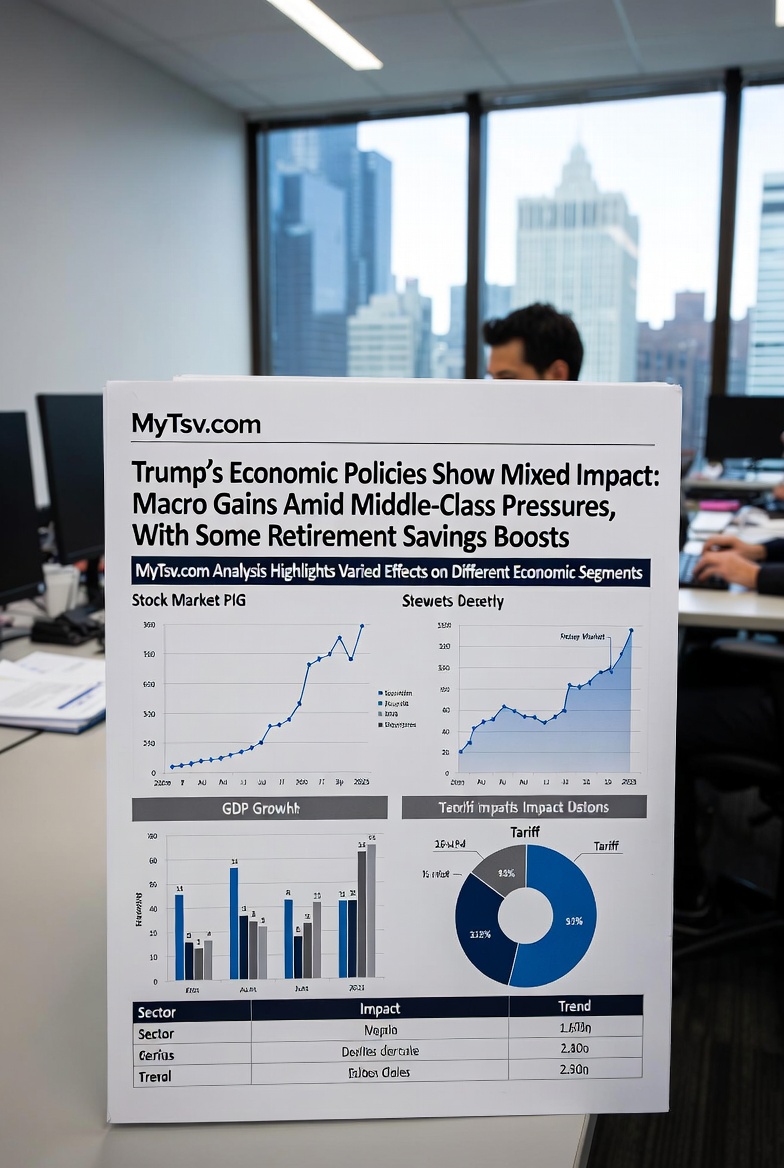
MyTsv.com analysis poster in a Chicago newsroom highlights the mixed effects of President Trump's 2025–2026 economic policies: strong macro gains in stock markets and GDP contrasted with middle-class cost pressures from tariffs, partially offset by enhanc
New Analysis: Trump's Economic Policies Deliver Strong Macro Gains but Impose Costs on Middle-Class Households, Offset by Targeted Retirement Savings Benefits
DEERFIELD, IL, UNITED STATES, February 16, 2026 /EINPresswire.com/ -- A comprehensive review of economic data one year into President Donald J. Trump's second term reveals a U.S. economy with notable strengths—including record stock market performance and projected GDP growth of 2.5–3% in 2026—while middle-class families face higher costs from tariffs and uneven tax relief. However, certain retirement-focused provisions offer meaningful advantages for middle-income savers.Broad tariffs implemented in 2025, ranging from 10–60% on imports from major partners such as China, Canada, and Mexico, have raised more than $200 billion in revenue to support programs including family bonuses. These measures have increased consumer prices for everyday goods, adding an estimated $1,700–$3,800 annually per household, with lower- and middle-income families experiencing the most significant proportional impact. Households in the second income decile may see disposable income reductions of 2.3–4%, or $980–$1,700 per year.
The One Big Beautiful Bill Act (OBBBA), signed into law in 2025, provides tax relief through expanded child tax credits (up to $2,200, indexed for inflation), elimination of taxes on tips (up to $25,000) and overtime (up to $12,500), and higher standard deductions. Middle-class households could see average federal tax savings of $900–$1,800. Distributional analyses, however, show that approximately 70% of net benefits accrue to the top 20% of earners, with the top 1% gaining over $50,000 per household on average, while the middle quintile receives about 10%. After accounting for tariff effects, many middle-income families may face net annual losses of $470–$2,000.
Other pressures include slowed job growth (50,000 net additions in December 2025, down sharply from prior levels), more than 1.2 million layoffs announced in 2025, and unemployment at 4.4%. Inflation stands at 2.7% year-over-year, with tariffs contributing 0.5–1.5 percentage points. Proposed reductions to Medicaid and SNAP, exceeding $1 trillion to offset tax cuts, could affect millions' access to health coverage and food assistance.
Consumer confidence remains subdued at approximately 57 on the University of Michigan index, with 65% of Americans viewing the policies as favoring the wealthy, 18% reporting personal financial improvement, and 70% concerned about tariff impacts.
On the positive side for middle-class retirement planning, OBBBA and related reforms enhance 401(k) and similar accounts. Catch-up contribution limits for workers aged 50+ increased in 2025: an extra $7,500 for ages 50–59 and 64+, and $11,250 for ages 60–63, enabling greater tax-deferred savings. A new $6,000 annual income tax deduction (or $12,000 for joint filers) for those 65+ from 2025–2028 provides additional support for retirees. The Trump Accounts initiative, seeded with a $1,000 government contribution for eligible children born after 2025, allows up to $5,000 in annual contributions for long-term goals, with tax advantages benefiting middle-class families.
Administration officials point to rising blue-collar wages, prioritized employment for native-born workers, and potential rebate programs funded by tariffs as drivers of broader prosperity, with forecasts for possible 4–6% growth in 2026.
February's jobs and CPI reports will provide further clarity on the trajectory ahead of the 2026 midterms.
About This Analysis
This report is published on MyTsv.com, a leading online platform dedicated to empowering consumers and businesses through trusted local services, reviews, and guides. MyTsv.com's mission is to simplify everyday decision-making by offering searchable directories, promotional videos, and localized listings across categories including healthcare, automotive, legal, fitness, and more. Its concept centers on promoting transparency, quality, and community connections in local economies. For the full report, methodology, or inquiries, contact: info@mytsv.com.
Eugene Kolkevich
MYTSV
+1 6302977501
email us here
Visit us on social media:
LinkedIn
Instagram
Facebook
YouTube
TikTok
Legal Disclaimer:
EIN Presswire provides this news content "as is" without warranty of any kind. We do not accept any responsibility or liability for the accuracy, content, images, videos, licenses, completeness, legality, or reliability of the information contained in this article. If you have any complaints or copyright issues related to this article, kindly contact the author above.
